

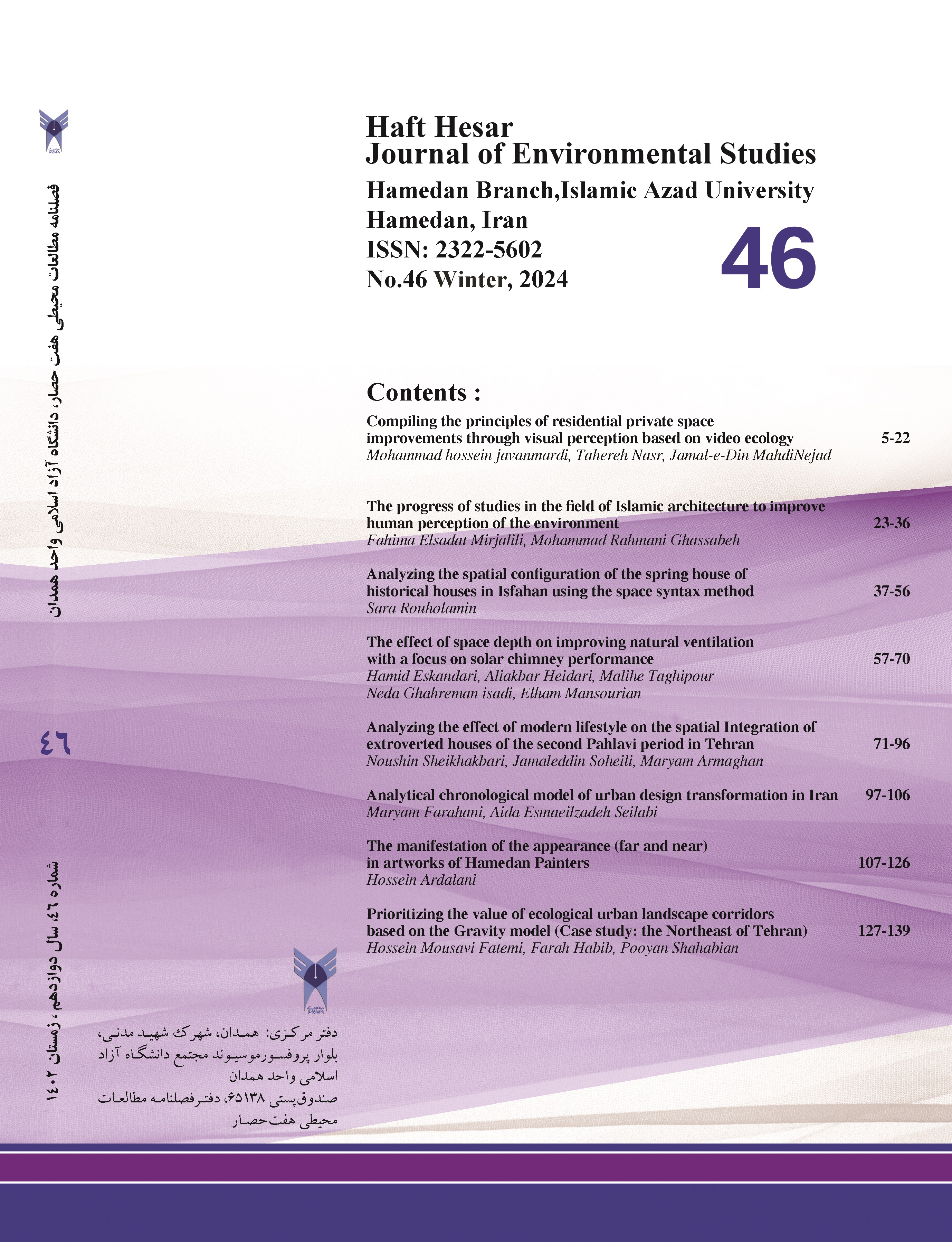


- Year 2021
- Year 2026
- Year 2025
- Year 2024
- Year 2023
- Year 2022
-
 The analysis of the Influence of Sign Legibility on Tourists’ Perception and Behavior
(Case Study: The Historical District of Qazvin) The Impact of Physical and Psychological Quality of School Environments and Behavioral Contexts on Students' Academic Self-Concept
(Case Study: Secondary Schools in the City of Isfahan) Investigating the spatial organization in mosques (Qajar period of Shiraz) Increasing the Satisfaction of the Older Adult Based on Maslow's Needs with an Emphasis on the use of the Central Courtyard Case study (Private Nursing Homes in Tehran) Reinterpreting the Concept of the Street in Contemporary Iranian Cities
(Case Study: Hamzeh Boulevard, Kerman) Facilitating socialization in the central neighborhood of Tehran metropolis through national media based on thematic analysis approach* Genealogical Analysis of Residential Architecture in the Oil Cities of Khuzestan: Masjed Soliman, Abadan, and Ahvaz Assessing and Ranking the Readiness of Sanandaj’s Urban Districts for Smart City Adoption: A Human-Centric Approach Natural Elements and the Formation of Sense of Place in the Historic Houses of Ahvaz: A Case Study of Saray-e Moin-ol-Tojjar Analysis of Spatial Justice in the Distribution of Services and Facilities with an Emphasis on Good Urban Governance: A Case Study of Poldokhtar
The analysis of the Influence of Sign Legibility on Tourists’ Perception and Behavior
(Case Study: The Historical District of Qazvin) The Impact of Physical and Psychological Quality of School Environments and Behavioral Contexts on Students' Academic Self-Concept
(Case Study: Secondary Schools in the City of Isfahan) Investigating the spatial organization in mosques (Qajar period of Shiraz) Increasing the Satisfaction of the Older Adult Based on Maslow's Needs with an Emphasis on the use of the Central Courtyard Case study (Private Nursing Homes in Tehran) Reinterpreting the Concept of the Street in Contemporary Iranian Cities
(Case Study: Hamzeh Boulevard, Kerman) Facilitating socialization in the central neighborhood of Tehran metropolis through national media based on thematic analysis approach* Genealogical Analysis of Residential Architecture in the Oil Cities of Khuzestan: Masjed Soliman, Abadan, and Ahvaz Assessing and Ranking the Readiness of Sanandaj’s Urban Districts for Smart City Adoption: A Human-Centric Approach Natural Elements and the Formation of Sense of Place in the Historic Houses of Ahvaz: A Case Study of Saray-e Moin-ol-Tojjar Analysis of Spatial Justice in the Distribution of Services and Facilities with an Emphasis on Good Urban Governance: A Case Study of Poldokhtar
Principles of Transparency
Peer-review process
All submitted articles are evaluated at the submission to meet the structural and subject principles of Haft Hesar. The matched articles will go under a double-blinded peer-review process by at least 3 reviewers (experts in the field who are not part of the journal’s editorial staff) who are selected by the Editorial Board members according to their field specialties. The Editorial Board members have the final responsibility to select the articles.
Governing body
Haft Hesar is under the scientific control of the Editorial Board whose members are recognized experts in the subject areas included within the journal’s scope. Some executive roles of the Editorial Board members are delegated to the Editor-in-Chief who is well-known in the journal’s scope.
Editorial team
Haft Hesar is under the scientific supervision of the Editorial Team whose members are all experts with a high number of publications in their field.
Author fees/Access
There are No Fees or Charges at submission, reviewing, and publishing processes in Haft Hesar.
Haft Hesar follows the Bethesda Statement on Open Access Publishing.
Copyright
The content of Haft Hesar is published under the Creative Commons Attribution-NonCommercial 4.0 International Public License. To the extent this Public License may be interpreted as a contract, Haft Hesar is granted the Licensed Rights in consideration of your acceptance of these terms and conditions, and the Licensor grants You such rights in consideration of benefits the Licensor receives from making the Licensed Material available under these terms and conditions.
Haft Hesar allows the authors to hold the copyright without any restriction and the material is freely presented to the readers and can be used according to Creative Commons Attribution-NonCommercial 4.0 International Public License.
Process for identification of and dealing with allegations of research misconduct
Publisher and editors of Haft Hesar are reasonable to identify and prevent the publication of papers where research misconduct has occurred, including plagiarism, citation manipulation, and data falsification/fabrication, among others. In doing so, Haft Hesar follows COPE’s guidelines in dealing with allegations.
Ownership and management
Haft Hesar is owned and published by Islamic Azad University, Hamedan Branch, Iran.
Conflicts of interests
All Haft Hesar Editorial Board members and the Editor-in-Chief submitted articles are gone under the same reviewing process as the other authors are gone. In the cases that a reviewer suspects an undisclosed conflict of interest in a submitted manuscript or a reader suspects an undisclosed conflict of interest in a published article Haft Hesar will follow COPE’s guidelines.
Revenue sources/Advertising/Direct marketing
Haft Hesar is financially supported completely by Islamic Azad University, Hamedan Branch, Iran, and has no other sources for earning funds. Haft Hesar accepts No advertisements on the site or even as a report article.
Publishing schedule/Archiving
Haft Hesar has published 4 issues per year. All the content from the beginning to the end will be available forever on the Haft Hesar exclusive website. Also, Haft Hesar has the plan to enter the EBSCOhost and Scopus, and Clarivate Analytics databases.
Journal Information
- Current Issue: 2026، Volume 15، Number 55
- Owner: Islamic Azad University, Hamedan Branch
- Publishing Frequency: Quarterly (4 Issues per Year)
- Start Publishing Year: 2012
- Article Access: Open (Free of Charge)
- Language: Persian Full-text/English Abstract (250words)
- Releasing Fee: None
- Referencing Method: APA
- eISSN: 2717-4174

- pISSN: 2322-5602
Journal Staff
- Editor-in-Chief: Hamid Majedi
- Manager-in-Charge: Kianoosh Zakerhaghighi
- Executive Manager: Abbas Fakhraee
Publisher
Indexing Databases

Registered in

Open Access Policy
Haft Hesar follows the Bethesda Statement on Open Access Publishing

Newsletter subscription
Enter your email address to have site news and announcements delivered directly to your inbox.
Site Statistics
- Registered users: 1840 users
- Online users: 0 users
- Guest users: 56 users
- All visits: 6941014 visits
- Visits in 24 Hours: 3714 visits
- Total articles: 1991 articles
- Published articles: 524 articles
Copyright Policy

Haft Hesar Journal of Environmental Studies is licensed under a Creative Commons Attribution-NonCommercial-ShareAlike 4.0 International License.
